Let’s start with the obvious.
Aerospace is unforgiving.
Aircraft operate at 35,000 feet, 500 miles per hour, with hundreds of lives depending on every component working exactly as designed. High heat. High stress. Constant vibration. Rapid pressure changes. Extreme conditions that would destroy ordinary parts.
A small dimensional error? That’s not a minor inconvenience. That’s a potential safety issue. That’s aircraft grounded. That’s careers ended.
That’s why CNC machining dominates aerospace manufacturing. The precision, repeatability, and reliability these applications demand simply can’t be achieved any other way.
Here’s what makes aerospace CNC different from everything else.
Snapshot
| Factor | Aerospace Reality |
| Typical tolerances | ±0.0005″ to ±0.001″. Critical parts go tighter. |
| Cost per part | $150–$2,500+. Geometry, material, and tolerance drive it. |
| Common materials | Aluminum, titanium, stainless, Inconel, hardened steels |
| Part lifespan | Decades when made to spec. Built to last. |
| Compliance | FAA, AS9100 requirements. Non-negotiable. |
Why Precision Is Non-Negotiable
Aerospace manufacturing is one of the most demanding industries on the planet. Every component must perform perfectly under conditions that would destroy ordinary parts.
A slight defect or misalignment can weaken a part. And weakened parts in aircraft? That puts lives at risk. Period.
Here’s what precision actually delivers.
Safety
Aircraft push materials to their limits. Load cycles. Heat stress. Vibration. Pressure changes. Precision machining eliminates the variability that could create weak points. Every component can withstand what it’s designed to withstand.
Reliability
Engine components, actuators, landing gear, flight-control systems—these things have to work flawlessly for thousands of hours. Not sometimes. Every time. Tight tolerances and clean surface finishes reduce friction, improve wear resistance, and extend part lifespan dramatically.
Performance
Precision-machined surfaces improve airflow and reduce drag. Engines run more efficiently. For airlines, even small efficiency improvements translate into major fuel savings over millions of flight miles. The math adds up fast.
Compliance
FAA and AS9100 standards demand consistent quality, traceability, and repeatability. Precision machining delivers all three. Every part identical from run to run. Documentation that proves it.
How CNC Achieves Aerospace-Grade Accuracy
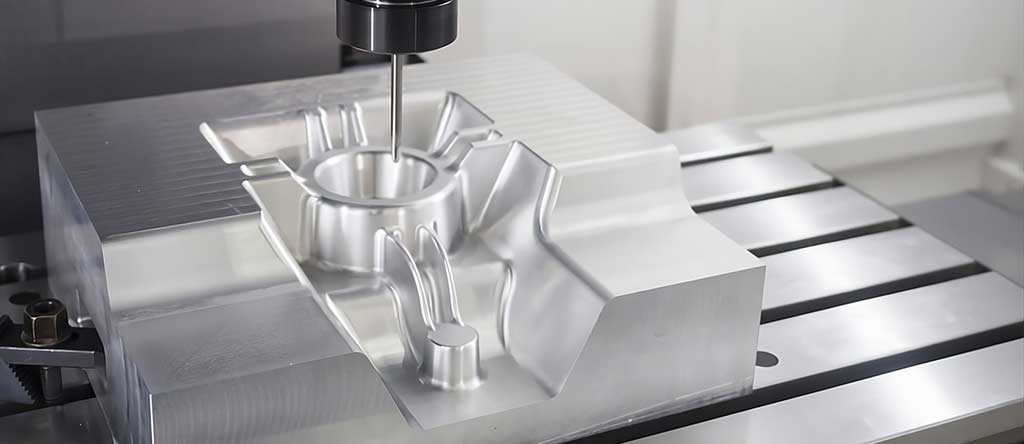
Modern CNC technology is built for this. Accuracy, consistency, and speed—all essential for aerospace work.
Every part starts with a CAD/CAM program that directs the machining process. Digitally controlled motion. No guesswork. No interpretation. Once the program is validated, you produce identical parts batch after batch. Part one matches part five hundred.
I’ve seen production runs where inspectors couldn’t tell first articles from last articles. That’s what digital control delivers.
Multi-axis machining—4-axis, 5-axis—handles the complex geometries aerospace demands. Curves, angles, pockets, aerodynamic shapes that require multiple cutting angles. 5-axis lets manufacturers create complex parts in a single setup. Fewer setups means fewer errors. Fewer errors means better parts.
Turbine blades. Engine housings. Structural brackets. Wing components. All made possible by multi-axis capability.
Advanced tooling handles the brutal materials aerospace requires. Carbide, ceramic, PCD—cutting tools designed to maintain accuracy even when machining titanium and Inconel. These materials destroy ordinary tooling. Aerospace tooling is engineered for the punishment.
Smart sensing and real-time monitoring keep everything in check. Sensors measure tool pressure, temperature, vibration. Automated corrections maintain tolerances during long machining cycles. Hours of cutting, micron-level accuracy throughout. The machine watches itself.
Common Aerospace Applications
CNC machining plays a role in nearly every major aircraft system.
Engine and turbine components. These parts tolerate extreme heat and rotational speeds that would destroy ordinary metal. Precision ensures proper airflow, balance, and structural integrity. Get the balance wrong by a fraction of a gram and you get vibration. Vibration causes wear. Wear causes failure.
Landing gear. Some of the largest loads on an aircraft happen during landing. Thousands of pounds of force, repeated thousands of times over the aircraft’s life. Precision machining ensures smooth movement and the structural reliability to handle it all.
Structural airframe parts. Ribs, brackets, spars—all require accurate dimensions for proper weight distribution and strength. The airframe holds everything together. Every joint, every fastener hole, every mating surface has to be right.
Avionics housings. Machined enclosures protect sensitive electronics from vibration, temperature swings, and electromagnetic interference. The brains of the aircraft need protection. Precise enclosures provide it.
Flight control components. Actuators, linkages, control surfaces—parts that move and parts that guide movement. All machined to tolerances that ensure predictable, reliable operation.
CNC vs. Other Methods
Aerospace companies compare CNC to other processes. Here’s how they stack up.
| Method | Best For | Limitations |
| CNC Machining | High precision, tight tolerances, critical parts | Material waste, setup time |
| 3D Printing | Lightweight structures, rapid prototyping | Surface finish, material strength limits |
| Casting | High-volume, basic shapes | Less accurate, needs secondary machining |
| Sheet Metal | Lightweight enclosures | Not for high-stress applications |
Many aerospace manufacturers now use hybrid approaches—combining CNC with additive to reduce waste and optimize shapes, with final precision machining to ensure tolerances.
What Drives Cost
Several factors affect aerospace machining cost. Understanding them helps you plan and budget.
Material selection. Titanium and Inconel are expensive and brutal to machine. More tool wear. Slower cutting speeds. Higher cost per part. But sometimes those materials are the only option that meets the performance requirements.
Part complexity. Complex geometries need multi-axis machining. More axes, more cost. But also better parts with fewer setups and fewer accumulated errors.
Tolerance requirements. Tighter tolerances mean slower feed rates and more quality checks. Only specify tight where you actually need it. Over-tolerancing drives cost without adding value.
Surface finish specs. Polishing, deburring, coatings, heat treatment—all add cost. Sometimes necessary for function or compliance. Sometimes not. Know the difference.
Production volume. Short runs cost more per part because programming and setup are fixed costs divided across fewer pieces. That’s the reality of aerospace prototyping and low-volume production.
The Aerospace Machining Workflow
Here’s how aerospace projects typically work.
Step 1: Design review. Examine the CAD, understand requirements.
Step 2: Material selection and sourcing. Get the right alloy from approved suppliers.
Step 3: CAM programming and simulation. Generate toolpaths, verify before cutting.
Step 4: First-article production. Make one, check everything.
Step 5: CNC machining. Multi-axis milling, turning, whatever the part needs.
Step 6: In-process quality checks. Verify as you go.
Step 7: Secondary finishing. Grinding, coating, heat treatment as required.
Step 8: Final inspection and compliance verification. Document everything.
Structured process. Traceable results. That’s how aerospace works.
Industry Trends
A few things shaping aerospace machining right now.
Electric and hybrid aircraft development is driving demand for lightweight, high-strength parts. New propulsion systems mean new component designs. New challenges for machining.
Short-run prototyping demand keeps rising. Rapid design changes and R&D cycles need fast turnaround. Weeks, not months.
Automation and AI-driven machining are improving speed and reducing errors. Machines that optimize cutting parameters themselves. Less human intervention, better results.
Hybrid manufacturing—CNC plus additive—enables new geometries and weight savings that neither method achieves alone. Print the near-net shape, machine the critical surfaces.
AS9100 adoption continues expanding as FAA expectations tighten. Quality systems that were optional are becoming mandatory.
The direction is clear. More precision, more automation, more documentation. Shops that can’t keep up will lose aerospace work to those that can.
FAQs
What tolerances are typical for aerospace CNC?
Most parts fall within ±0.0005″ to ±0.001″. Critical components go tighter—micrometer-level when required.
Why does 5-axis matter for aerospace?
Complex shapes in fewer setups. Better accuracy. Less chance for human error during repositioning.
What materials are most common?
Aluminum, titanium, stainless steel, Inconel, and specialized heat-resistant alloys. Each chosen for specific performance requirements.
How long does aerospace machining take?
Simple parts might be hours. Complex multi-axis components can take days. Material hardness and tolerances drive the timeline.
Who else uses aerospace-grade machining?
Space exploration, defense, robotics, high-performance automotive. Any application where failure isn’t an option.
What certifications matter?
AS9100 is the big one for aerospace quality management. ITAR registration for defense work. ISO 9001 as a baseline.
Why Styner Machine Tools
Styner Machine Tools provides advanced CNC machining for aerospace applications.
Tight-tolerance milling and turning. Complex multi-axis work. Short-run prototyping. Full compliance support.
When aerospace projects need extreme accuracy, Styner delivers.